
Issue #200: February 2026
Charter values, reviewability, Clearview AI

Dear readers,
Two papers for your reading pleasure:
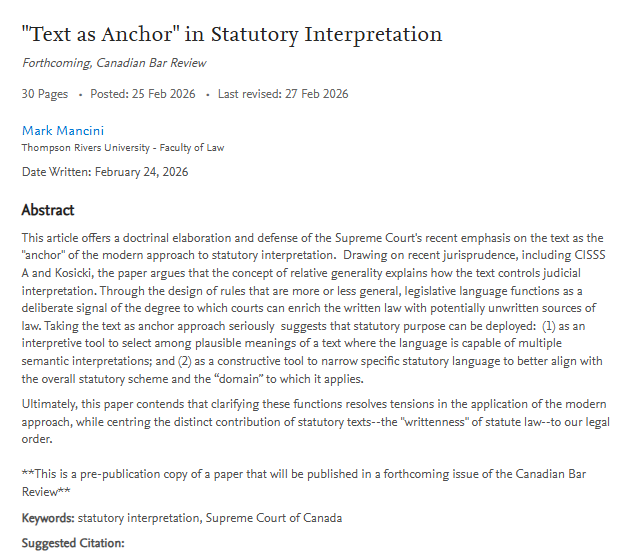
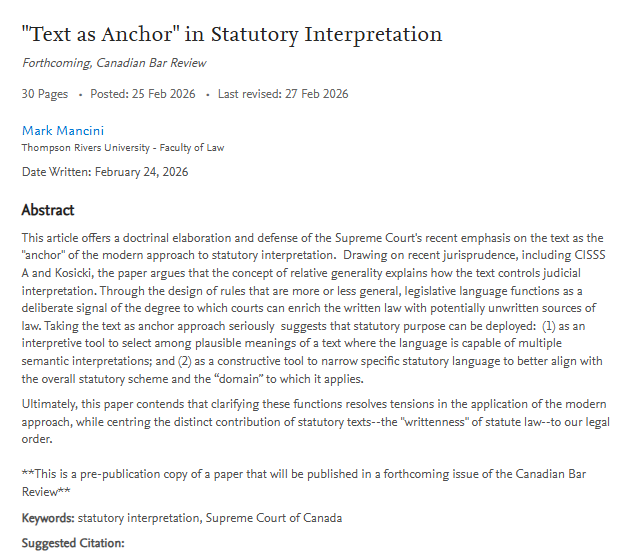
I have written many times in this newsletter about the Supreme Court’s recent focus on the text as the “anchor” of the modern approach to statutory interpretation. Many are wondering what this might mean. In a paper forthcoming in the Canadian Bar Review, I tackle this question head-on (“Text as Anchor” in Statutory Interpretation”). Here is the abstract:
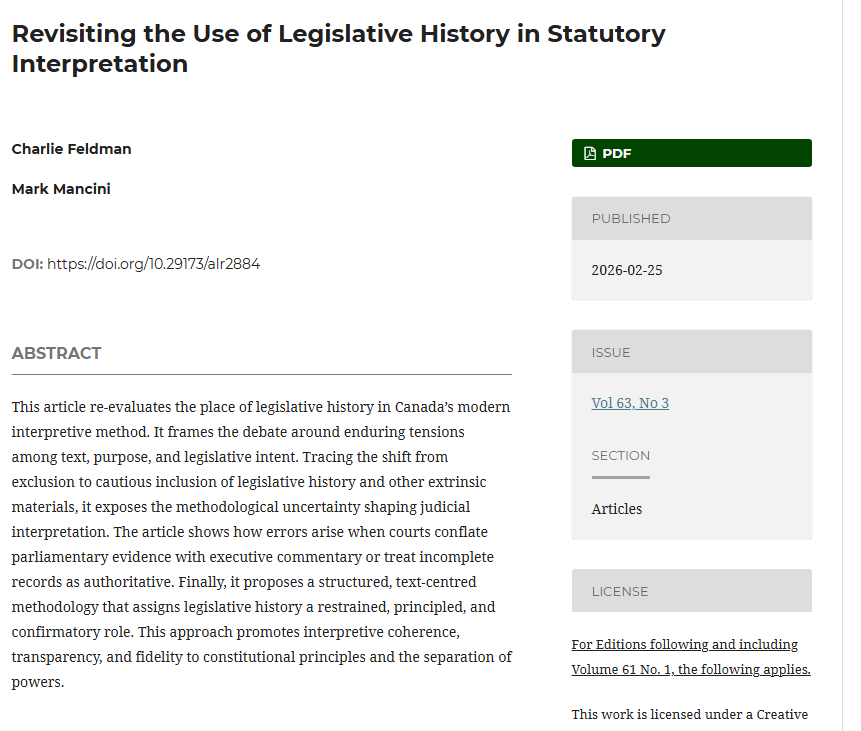
With my friend Charlie Feldman, we have a paper now out in the Alberta Law Review, entitled “Revisiting the Use of Legislative History in Statutory Interpretation.” Here is the abstract for that one:
Charter Values
Égalité Santé en français N.-B. Inc. et al v. Province of New Brunswick (Executive Council Office) et al., 2025 NBBR 302
The Charter Values Saga lives on.
Recently, the Supreme Court granted leave on Vabuolas v British Columbia (Information and Privacy Commissioner), 2025 BCCA 83 (Issue #172). Readers will recall that, in that case, Horsman JA raised several outstanding issues surrounding the Charter values jurisprudence. The leave materials demonstrated the parties’ interest in these issues.
This dispute arises from the New Brunswick government’s decision to remove the board of directors of the Vitalité Health Network, who were elected by the Francophone community. They were replaced with an unelected trustee. The applicants argue that this decision violated the constitutional rights of the Francophone minority community – specifically they argue that the network is a distinct institution protected by the Charter (fundamental right of community governance and control) [1]. They argue that the right to separate institutions under s. 16.1 of the Charter necessarily includes a right of management and control by the Francophone minority over the institutions as community management is necessary to achieve the objective of s. 16.1 (the preservation and promotion of the minority language and culture) [45].
The province argued that its decision was justified because there is a crisis in the health care. Appointing the trustee was a necessary temporary measure in the public’s interest to stabilize the system, remove bureaucratic barriers and rapidly implement the Provincial Health Plan. [2 and 23] . The province also argued that a right to manage health institutions by the Francophone community is not a right recognized by the Constitution. Provinces have the exclusive jurisdiction over hospital administration. [2]
Issues: (1) What is the standard of review? (2) Is the decision wrong because it fails to properly account for Charter values and unwritten principles?
Holding and Analysis: The decision fails on any standard of review.
Readers will be familiar with litigation in the province of New Brunswick on Charter values. In Minister of Justice and Public Safety v Forum des maires de Péninsule acadienne Inc., 2025 NBCA 99 (Issue #191), the NBCA overturned a decision of Bourque J at the King’s Bench, which concluded that the closure of courthouses violated the values underlying s.16.1 of the Charter. LeBlanc JA warned that the use of Charter values—undefined as they are—could be dangerous. In a particularly important passage, relying on Stratas JA’s decision in Singh Brar v Canada (Public Safety and Emergency Preparedness), 2024 FCA 114, LeBlanc JA concluded that “[e]xtending the scope of s.16.1 by way of values that exceed those expressed therein would constitute an inadmissible change to this provision.” I thought this was a good warning, paring back the worst of the Supreme Court’s Charter values precedent
Bourque J, however, returns in this case to conclude that Charter values and the unwritten principles of constitutional law can impose a distinct obligation here. In my view, this case presents the same legal risks as Forum des maires did.
On the standard of review, Bourque J applies what is now standard law: the decision of whether the Charter is engaged and applies in a particular case is subject to review on correctness (York Region District School Board v. Elementary Teachers’ Federation of Ontario , 2024 SCC 22; see also Issue #184); if engaged, whether the right is properly balanced with statutory objectives is reviewed on reasonableness (see Vabuolas, Issue #172; see, more centrally, CSFTNO, 2023 SCC 31, Issue #117 ). As far as this goes, this is true (though, as I will point out, Bourque J arguably misapplies this framework), but it will be interesting to see what the Supreme Court does with Vabuolas. But, centrally, the CSFTNO framework permits and encourages decision-makers to take account of Charter values, even where they are not argued or even where the Charter does not apply. Some lower courts have rejected this invitation (as the NBCA case shows), properly so, but Bourque J does not.
Bourque J, bound by Forum des maires, first concludes that although health institutions can play a crucial role in the development of the Francophone community, s.16.1 does not impose a constitutional obligation itself on the government—the text of the provision simply does not require this. This is where the penumbral version of Charter values inaugurated in CSFTNO rears its ugly head—it applies even where a Charter right does not. In other words, the case could have simply ended here.
Not so, in the wonderful world of Charter values. Bourque J begins her analysis by outlining the alleged Charter values at stake: equality of status, rights, and privileges between the French and English communities [89]; the remedial purpose of language rights [90]; and the right to distinct institutions and governance. According to Bourque J, once a government decision affects these abstract values, a decision can fall for being unreasonable: so, here, the decision affects the Francophone community’s ability to participate in the functioning of one of its institutions [96].
One might think this runs counter to the NBCA decision in Forum des maires. Bourque J disagreed [97]. She says that in this case the evidence demonstrates a strong link between these values and the decision—ie) the decision somehow adversely affects the values [98-102, 136, 139]. Based on the evidence, Bourque J concluded that the health network played an essential role in promoting the Francophone minority community, in health services and beyond; for example, the network provides clinical placements, residencies, and research activities in French for future health professionals [101].
As a result, Bourque J examined the Minister’s decision-making to determine whether he adequately grappled with the values at stake, as required under the reasonableness standard by CSFTNO. Bourque J found the decision lacking in this regard. The Minister did not produce “reasons” for this decision in the traditional sense, but generally justified the removal of the board through an appeal to the current state of the New Brunswick healthcare system, and later on justified the move by noting that the government appointed a Francophone trustee. But these justifications for Bourque J were unsatisfactory, and in the case of the trustee, was an ex post facto argument [108]. Similarly, the Minister’s lack of reasoning about the unwritten principle of the protection of minorities was fatal to the decision [137-138].
I will take this opportunity to renew some of my problems with the CSFTNO/Charter values framework, using this case as a foil. First, there is a problem in principle. As the NBCA noted in Forum des maires, one cannot—even indirectly—use the Charter values framework to impose obligations beyond the specific text of the Charter. This, along with cases like Brar, peeled back the most adventurous interpretations of CSFTNO, which could lead to a two-track Charter: an ordinary, run-of-the-mill Charter of Rights, and a more abstract, enigmatic Charter of Vibes. In this case, however, Bourque J embraces the more radical interpretation of CSFTNO. She admits—as she must, after Forum des maires—that s.16.1 cannot apply in its text to the health network. Therefore, she must rely on the Charter values framework to make it so.
Second, there are problems in practice. Bourque J’s decision rests on her ability to distinguish Forum des maires. She does so, apparently, on the evidence. But the Charter values framework gives us no standards to evaluate which cases present a strong link between a decision and values (thus warranting attention by a decision-maker) and cases which do not. At least some of the evidence cited by Bourque J merely declared the importance of the health network to Francophone cultural interests. One could have said the same thing about the courthouses at issue in Forum des maires. The worry becomes ad hoc decision-making.
Third, I worry about the burden that the Charter values framework puts on adjudicative decision-makers. The case law applying the CSFTNO framework matured in the language rights context, where ministerial decisions are at stake. In this context, it might be much easier to assume that Ministers should be aware of their Charter obligations. But CSFTNO does not just apply to ministerial decisions in the language rights context. It applies to the entire gamut of administrative decision-making. Adjudicative decision-makers who might have a complex record before them are asked to rely on CSFTNO in order to raise Charter values if there is a sufficient link on the facts. This, it bears repeating, asks decision-makers to deal with legal issues that may not have been argued and that may not be central to the resolution of the case. In turn, and as a result, the framework encourages the transformation of run of the mill administrative decisions into complex Charter cases on judicial review.
This is odd, because the Charter values framework was designed to be lead to an informal application of constitutional law, considering the reality that administrative decision-makers might not be lawyers. Ironically, the complexity of the Charter values framework requires these decision-makers to speculate about the presence of a potential constitutional issue, even when a Charter right strictly does not apply.
A final note on nomenclature in this case. Bourque J ultimately concludes that, on either a correctness or reasonableness standard, this decision does not survive [125-126]. The primary basis of the decision is that the decision is “incorrect’ under York [125]. But I do not think this is strictly true. York deals with cases where a Charter right applies and is engaged on the facts. The question then becomes whether the decision-maker properly appreciated that the Charter right was engaged. In York, the problem was the arbitrator’s application of an arbitral “balancing of interests analysis” rather than the s.8 search framework. That is not the case before Bourque J. Here, s.16.1 of the Charter is not engaged, and so York is not the proper framework. Rather, the only question is whether the decision failed to reasonably grapple with the impact on the Charter values in light of various statutory objectives. For what it is worth, Bourque J may be right that the evidence supports a strong link requiring consideration by the Minister. But again, we go back to the point of principle: if s.16.1 does not apply, what more is there for a court to do?
Reviewability
West Whitby Landowners Group Inc v Elexicon Energy Inc, 2025 ONCA 821
Context: This case concerns a “decision” by the Ontario Energy Board. The parties were engaged in negotiations over the provision of electricity to residential subdivisions. As part of their agreement, they agreed to be bound by the OEB’s conclusion on the application of a regulatory provision to the project. One of the parties wrote to the OEB and asked for a final determination in the name of the Board; Board staff responded in two letters expressing their “views and conclusions” on the application of the substantive law. On review, the Divisional Court concluded that it lacked jurisdiction to review the OEB staff letters, centrally because “the OEB did not exercise a statutory power of decision giving rise to judicial review within the meaning of s.2 of the Judicial Review Procedure Act” [10].
Issue: The question was whether the OEB letters were truly “decisions” attracting judicial review: that is, are they sufficiently public to warrant judicial review?
Analysis: The Court (per Sossin JA) concludes that both letters are reviewable, principally because the OEB staff exercised a statutory power of decision and the decision is of a sufficiently public character (see Highwood Congregation of Jehovah’s Witnesses (Judicial Committee) v. Wall, 2018 SCC 26).
There are two questions in these kinds of reviewability cases, set out by Rowe J’s reasons in Wall. First: did the decision-maker exercise a statutory power? Second: was the exercise of the power sufficiently public in character?
Sossin JA resolves this case on the first question through a rather orthodox application of the principles of statutory interpretation. Section 105 of the Ontario Energy Board Act empowers the OEB to resolve complaints/disputes through binding legal determinations of law and fact, and through “a wide range of dispute resolution mechanisms” [63]. For Sossin JA, “[n]othing in the text distinguishes between the OEB’s power to “mediate” and its power to “resolve”” [54], which means that the OEB could finally resolve a complaint in the manner it did [99].
One counter-argument raised by the OEB was that its staff simply have no power to decide anything, and that its “decision” was merely an “opinion” (a conclusion affirmed by the Divisional Court, see para 93-94). The OEB, in essence, argued that its authority could only be exercised through its Commissioners and through official orders [101]. Sossin JA rejects both arguments. As noted above, the exercise of power here was “discretionary,” but it was premised on the exercise of a statutory power. And, here, while the OEB is permitted to decide how best to exercise its functions, it does not only operate through the Commissioners. Rather, the statutory text grants exclusive jurisdiction to the Board [101].
With regard to the second issue—whether the exercise of the OEB’s power in this case was sufficiently public—there were two key factual issues. The first was whether it mattered the OEB’s role in this dispute was triggered by a private agreement; and whether it was fatal for a finding of jurisdiction that the OEB lacked a compulsory power. One might think that because the parties agreed to be bound by the OEB’s determination that its jurisdiction is predicated on a private act, and is thus unreviewable. Not so, according to Sossin JA, because the decision is grounded by a “clear statutory basis” [86]. As a result, the agreement itself “does not alter the public character of the OEB’s actions or the appropriateness of public law remedies” [86]. Nor was it fatal that the OEB decision did not come in the form of a binding instrument like an “order.” Here, “it was understood by the parties and by the OEB that its determination would have binding effect” [87].
A good set of reminders in this case about reviewability. For one, judicial review can sometimes run to unexpected places. Decision-makers need not exercise their powers in specific or particular ways to attract judicial review. At the same time, it is important that the role of judicial review be limited to the exercise of truly public powers, lest supervision over the machinery of government lead to micromanagement. In my view, the Wall test admirably walks this line. Here, while the OEB may have thought it was operating in the world of non-binding opinions, its own labelling or characterization of its power is not decisive on judicial review.
For an interesting application of Wall in Quebec, see the following case from this month:
Kahnawà:ke Gaming Commission c. Magic Palace, 2026 QCCA 200.
Statute Interpretation
Clearview AI Inc v British Columbia (Information and Privacy Commissioner), 2026 BCCA 67
Context and Analysis: From the Court’s summary
This appeal arises from a judicial review of the British Columbia Information and Privacy Commissioner’s decision that the appellant, Clearview AI Inc., contravened the Protection of Information and Privacy Act by collecting facial data of British Columbians from social media websites without their consent to use in its facial recognition business. The Commissioner prohibited Clearview from offering its facial recognition services in BC and required it to make best efforts to stop collecting facial data of British Columbians without their consent and delete the facial data of British Columbians in its possession.
The Court (per Iyer JA), concludes that PIPA is constitutionally applicable to Clearview, and that it was reasonable for the Commissioner to conclude that PIPA does not exempt Clearview from obtaining individual consent.
Among other things, Iyer JA’s conclusion is driven by an interesting point of statutory interpretation. Individual consent is not required under the legislative regime for information available to the public, including “a magazine, book or newspaper in printed or electronic form” [83]. Clearview argued that the meaning of “publication” could include social media sites. But Iyer JA, properly I think, rejects this interpretation. When statutes are designed in this way—with the word “including” followed by a list—any implied items have to be of the same kind as the existing words in the list. Iyer JA notes that the excepted materials in PIPA are “created primarily by their authors, no by the individual readers,” and that is different from social media [87].
This case is a good example of how courts are treating Clearview’s actions (see Issue #179). But, on interpretation, it is a classic example of the the ejusdem generis canon.
Disclaimer: Nothing in the SEAR is legal advice. The SEAR is not designed to be comprehensive. It is designed to collect some cases that I believe are interesting to practitioners and students, and to provide my quick thoughts. Not all of the cases presented are fully analyzed ie) I’ve selected the most relevant issues in some of the cases. Please complement the SEAR with your own research and study. Any mistakes are my own.