
Issue #188: August 10, 2025
Statutory interpretation, s.96, and more.

Greetings readers,
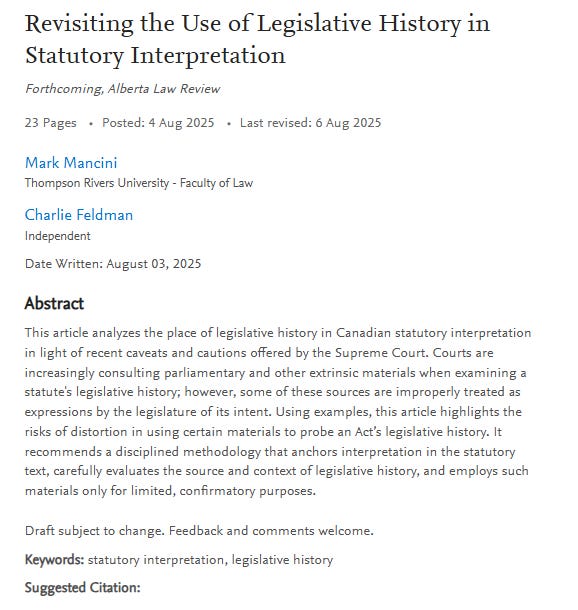
Another paper you might find interesting. This one, “Revisiting the Use of Legislative History in Statutory Interpretation,” is forthcoming in the Alberta Law Review. It is co-written with Charlie Feldman. The abstract is below:
Sahloul v Canada (Citizenship and Immigration), 2025 FC 1331 (July 25, 2025)
Category: Application of the reasonableness standard.
Context: This is a judicial review of a decision of a visa officer, refusing the applicant’s application for permanent residency in Canada as a Convention refugee abroad and a member of the humanitarian-protected persons abroad class [3]. The officer reasoned that the applicant “had not availed himself of the first opportunity for international protection…” [3]. The applicant feared persecution because of his participation in a protest in Syria [5-11].
Issue: Is the decision reasonable?
Holding: No.
Analysis: Régimbald J finds fault with this decision, broadly speaking, on two grounds. Both are worth thinking about.
First, Régimbald J concludes that the officer’s reasons were “bald, conclusory, and plainly unresponsive to the constraints bearing upon the decision” [16]. The problem was one of boilerplate, a sure-fire way to fail after Vavilov. As a result, “[n]othing in the Officer’s reasons demonstrate any sort of engagement with the stakes” [18].
Second, the officer erred by importing concerns about “asylum shopping” into its analysis of whether the applicant was a legitimate Convention refugee. As Régimbald J notes, because the Convention has been incorporated into Canadian law in the IRPA, “the interpretive methodology to be employed when construing a domestically incorporated international treaty essentially aligns with the modern principle of statutory interpretation as applied in Canadian courts” [42].
In explaining how to conduct this interpretation, Régimbald J draws an analogy to the ongoing clarifications in statutory interpretation. He notes that interpretation of the treaty depends, primarily, on its ordinary meaning [44, see also CISSS A, 2024 SCC 43 at para 24]. The text did not disclose a requirement for a potential refugee to seek asylum “at the earliest opportunity, or in the nearest Convention member state” [48]. This broad reading of the text aligned with the objective of the treaty, which contemplates a generous protection for the interests of the “displaced and persecuted” [51]. Here, the officer’s concern about “asylum shopping” surreptitously introduced a requirement into the text of the treaty.
This is a good example of the balance between text and purpose in statutory interpretation. When Parliament enacts a semantically-broad term, supported by an expansive purpose, it is inconsistent with that intention for a decision-maker to “read-in” requirements that do not appear in the text.
667895 BC Ltd v Delta (City), 2025 BCCA 279 (August 7, 2025)
Category: Application of the reasonableness standard.
Context: From the Court’s summary:
The appellant filed a land title petition seeking to cancel the dedication for highway use of a strip of land adjacent to its property along 90 Street. Previously, Delta had sought to sell 90 Street, considering it no longer of use. Delta now opposed the petition, based on an engineering department report recommending the land be retained for highway use. The appellant submitted a written response to the engineering report prior to Council’s hearing on the matter. Delta Council proceeded at the hearing to pass a resolution that the land was needed for highway purposes, preventing the appellant’s petition from moving forward. By section 132(4) of the Land Title Act, Delta was required to give written reasons for its decision upon request. When the appellant requested written reasons, Delta cited only the reasons set out in the engineering report—which had been issued before the appellant’s written response.
Issue: Is the Council’s adoption of the resolution reasonable? In particular, does the engineering report satisfy the statutory duty to give reasons?
Holding: The Court (per Grauer JA) allows the appeal and remits the matter to Delta’s Council.
Analysis: This case provides an interesting clarification. Delta tried to support its resolution by reliance on cases where Vavilov contemplated review in absence of “reasons.” This is a common problem in municipal council decision-making, particularly in the promulgation of bylaws. But, as Grauer JA notes, those cases are arguably inapposite—here, reasons were statutorily required [42]. Nonetheless, Grauer JA poses the problem as one of reasonableness: does the engineering report display the features of reasonableness defined in Vavilov?
The big problem, here, was that the reasons were prepared before the appellant had an opportunity to make submissions. As Grauer JA says, this does not itself make the resolution unreasonable. However, it does arguably make it more likely that the staff report will not “meaningfully address the concerns raised by the appellant” [56]. As with all reasons, the key question that must be answered is why: in this case, “why it would be appropriate to preserve the undeveloped dedication area for highway purposes notwithstanding the many concerns the appellant raised” [57].
Botbyl v Heartland Farm Mutual Inc, 2025 ONSC 3349 (July 29, 2025)
Category: Interpretation/s.96.
Context: This is a judicial review of a reconsideration decision of the Licence Appeal Tribunal. The applicants were involved in a motorcycle accident. They held two car insurance policies (one with Heartland and one with Economical), but due to an innocent mistake, they submitted their accident benefits application to the wrong insurer, following incorrect advice. The other insurer then denied the real claim on the basis that the insureds had already applied for benefits with another insurer.
At the first instance LAT decision, the adjudicator granted relief from forfeiture of their insurance policy, under s.129 of the Insurance Act. On reconsideration, the LAT reversed the adjudicator’s decision, holding that the LAT lacked jurisdiction to apply relief from forfeiture under s.129.
Issue: Does the LAT have jurisdiction under s.129? Bale J filed a concurring opinion.
Holding: The Court majority, per Sachs and Backhouse JJ, concludes that the LAT has jurisdiction to grant relief under s.129.
Analysis: The interpretive question here turned on the meaning of s.129. It permits a “court” to “relieve against the forfeiture or avoidance on such terms as it considers just.” The question is whether the LAT has jurisdiction to apply s.129. Heartland made several interesting arguments: (1) though the LAT is applying consumer protection legislation, the purpose of legislation “does not change the limits on its authority to grant relief” that is equitable in nature; (2) the word “court” in s.129 does not include the LAT; (3) an interpretation that granted the LAT power under s.129 would violate s.96 of the Constitution Act, 1867 because it would involve the transfer of a s.96 power—the power to grant equitable remedies—to a provincially-appointed tribunal.
Sachs and Backhouse JJ reject the argument that the LAT is not a “court.” They rely on Charter jurisprudence, particularly cases where the Supreme Court has held that the power to decide all questions of fact and law means that a tribunal is a “court of competent jurisdiction” for the purposes of s.24(1) of the Charter [69]. Though the Court acknowledges that the term “court of competent jurisdiction” does not appear in s.129, it recognizes that the LAT has been granted power to decide all factual and legal issues before it, indicating that the legislature “has not defined the word ‘court’ in a manner that narrows its meaning” [70]. Moreover, the Court was convinced that the consumer protection mandate of the SABS should be decisive. This, in the face of an argument that another part of the Insurance Act uses the term “court” to exclude the LAT, which the presumption of consistent expression would consider important [74-75].
For my part, I am uncomfortable with the idea that Charter jurisprudence and the overall purpose of the SABS should be the starting point. In terms of the Charter, there is a fundamental difference between the scope of the Charter—which administrative tribunals should be able to apply to ensure its full protections—and an ordinary statute. Rather than starting from a definition used in another, different legal context, the Court should have provided reasons why the word “court” in the Insurance Act includes the LAT.
Sachs and Backhouse JJ attempt to meet this problem by relying on the protective purpose of the SABS. In so doing, they reject the argument that the “presumption of consistent expression” is decisive. They reason that because the “Insurance Act is a statute that has undergone a number of amendments over the years. Therefore, it is not surprising that there are variations of meaning within its text” [81]. Without more, I do not find this argument particularly convincing. For one, it is unclear whether, in the specific case of s.129 and s.23, there is any reason to believe that there is a discrepancy in the meaning of “court.” Sachs and Backhouse JJ offer no evidence that this is the case. Moreover, even if the presumption of consistent expression is not relevant, Sachs and Backhouse JJ should have provided textual evidence that the term “court” includes the LAT. It is one thing to confirm that evidence through reflection on the purpose of the SABS. It is another to say that the purpose of the SABS compels a meaning of the word without any evidence that its ordinary meaning supports that conclusion.
Dealing with the s.96 argument, Sachs and Backhouse JJ conclude that it is incorrect to ask whether the LAT could provide equitable remedies as a constitutional matter. They are right to draw this conclusion. As they say, Sobey’s Stores v Yeomans, [1989] 1 SCR 238 held that when characterizing whether a novel jurisdiction intrudes on s.96, one must consider the substantive nature of the dispute rather than whether the new tribunal exercises a specific remedial power held by the courts. If the superior courts held exclusive jurisdiction over the dispute in 1867, then there may be a constitutional problem with the tribunal. However, in this case, statutory accident benefits were not in the exclusive jurisdiction of superior courts, with no comparable cause of action in those courts—and therefore, there is no constitutional problem.
Disclaimer: Nothing in the SEAR is legal advice. The SEAR is not designed to be comprehensive. It is designed to collect some cases that I believe are interesting to practitioners and students, and to provide my quick thoughts. Not all of the cases presented are fully analyzed ie) I’ve selected the most relevant issues in some of the cases. Please complement the SEAR with your own research and study. Any mistakes are my own.